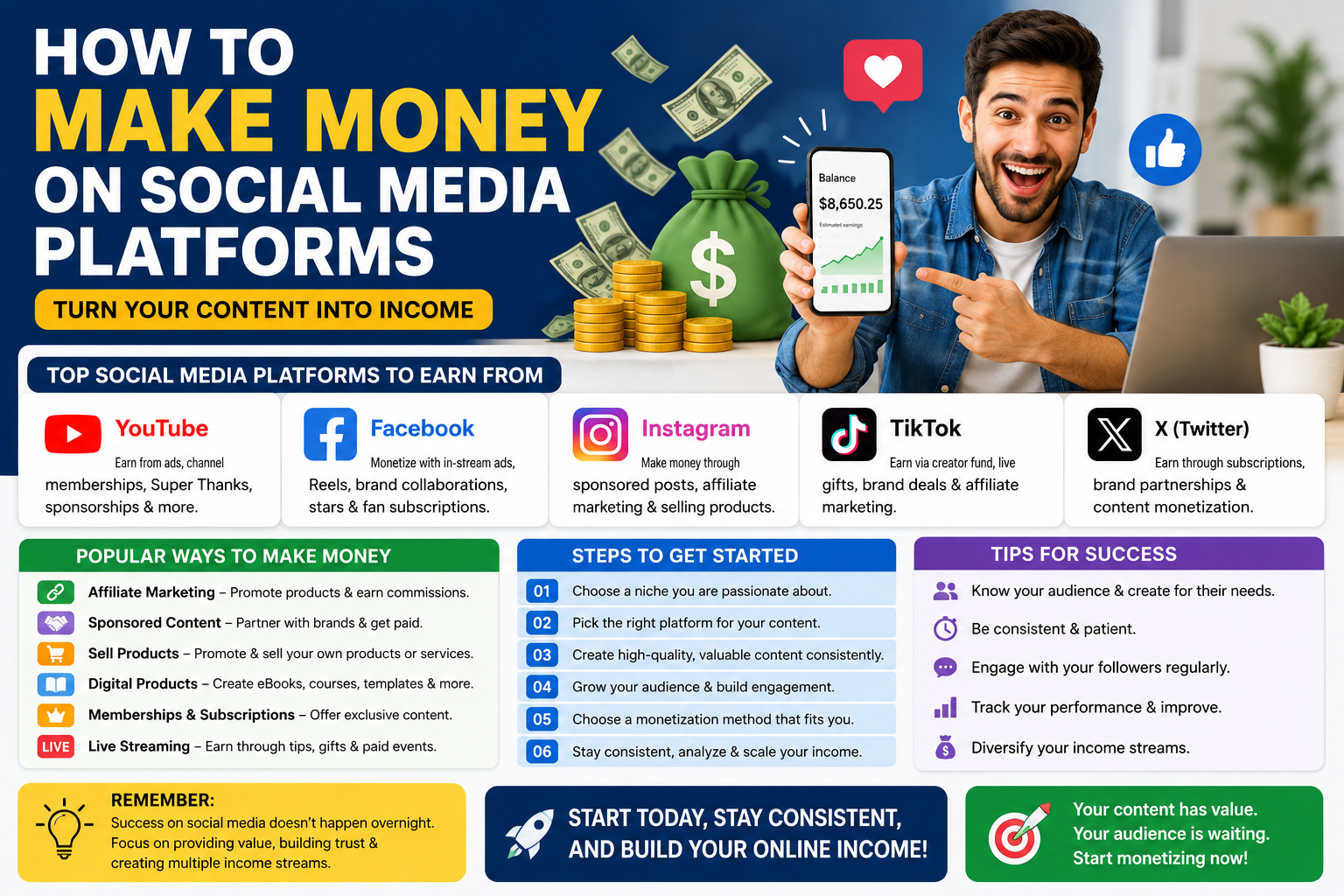
Social media is no longer just a place to share photos, watch videos, or connect with friends. It has become a serious business opportunity for creators, freelancers, influencers, entrepreneurs, and small businesses. Platforms such as YouTube, Facebook, Instagram, TikTok, and X allow people to build an audience and turn that audience into potential income through different monetization methods.
If you are searching for how to make money through social media, it is important to understand that success is not based on followers alone. A profitable social media presence requires valuable content, consistency, audience trust, and a monetization strategy that fits your niche.
Some creators earn through advertising, while others focus on sponsorships, affiliate marketing, digital products, services, memberships, or physical products. Many successful creators combine several of these methods instead of depending on a single source.
In this guide, we will explore practical ways to make money on social media, including how monetization works on five major platforms, how many followers you may need, how much you can potentially earn, how long it can take, and how to turn social media activity into a sustainable online business.
Why Social Media Has Become a Business Opportunity
The biggest advantage of social media is the ability to reach a large and targeted audience without needing a traditional storefront. A smartphone, internet connection, and useful content can be enough to begin building an online presence.
For example, a technology creator could publish smartphone tutorials and eventually generate revenue from advertising, affiliate recommendations, sponsorships, and digital products. A fitness creator could share free workout content and later offer coaching, fitness guides, memberships, or relevant products.
This shows why money making with social media is about more than getting views. Content can introduce your brand to potential customers, build trust, demonstrate your expertise, and eventually lead to a purchase or business relationship.
The key is to think of social media as part of a larger business system rather than simply a place to collect likes and followers.
Choose the Right Social Media Platform for Your Goals
Before you try to make money on social media platform channels, decide where your content is most likely to perform well.
YouTube is ideal for long-form videos, tutorials, reviews, educational content, entertainment, and Shorts. Facebook is useful for Reels, videos, Groups, Pages, communities, and business promotion. Instagram works particularly well for visual content, personal brands, Reels, Stories, and product promotion. TikTok is focused heavily on short-form video and content discovery, while X can be valuable for written content, expertise, discussions, and professional networking.
You can eventually use multiple platforms, but starting with one primary platform can make it easier to understand your audience and improve your content.
Make Money on YouTube With Video Content
YouTube is one of the most established platforms for creators who want to build a long-term video business. Its search functionality also means useful videos can continue attracting viewers well after they are published.
Creators can potentially make money on YouTube through advertising, YouTube Premium revenue, memberships, Super Chat, Super Stickers, Super Thanks, Shopping-related features, sponsorships, affiliate marketing, products, and services.
YouTube’s Partner Program has different eligibility requirements depending on the monetization features a creator wants to access. For full advertising revenue eligibility, YouTube currently requires 1,000 subscribers plus either 4,000 valid public watch hours in the previous 12 months or 10 million valid public Shorts views during the previous 90 days. YouTube also offers an expanded Partner Program entry level in eligible countries for certain fan-funding and Shopping features.
YouTube Monetization Steps
Start by choosing a specific niche and creating a channel around it. Prepare content that answers questions, solves problems, teaches skills, reviews products, or entertains your target viewers.
Publish consistently and improve your titles, thumbnails, audio, editing, and introductions. Watch your analytics to understand audience retention, watch time, views, and subscriber growth.
When your channel meets the requirements for the relevant Partner Program features, open the Earn section in YouTube Studio and follow the application process. You may need to accept applicable terms and connect an AdSense for YouTube account before the channel can be reviewed.
After approval, activate the monetization features available to your channel and continue creating original, policy-compliant content.
How Much Can You Make on YouTube?
There is no guaranteed amount of money for a particular number of views. Revenue can depend on audience location, content category, advertiser demand, viewer behavior, video format, and other factors.
For example, a hypothetical RPM of $5 would produce approximately $500 from 100,000 monetized views, while a hypothetical RPM of $10 would produce approximately $1,000. These numbers are only examples and should not be considered guaranteed YouTube earnings. YouTube itself states that there are no guarantees regarding how much a creator will be paid.
Creators who want to earn money on social media should therefore consider combining advertising with other income sources.
Make Money on Facebook With Videos and Communities
Facebook provides several opportunities for creators, businesses, and community builders. Pages, Groups, Reels, videos, live content, and messaging can all be used to develop an audience.
Eligible creators may be able to make money on Facebook through available Meta monetization programs, fan-support tools, sponsorships, affiliate marketing, products, and services.
Monetization availability can vary based on factors such as location, account status, content, eligibility, and current Meta programs. Because these requirements can change, creators should check their Professional Dashboard for the features available to their specific account.
Facebook Monetization Steps
Create a professional presence around a specific niche and publish original content that your target audience finds useful or entertaining.
Experiment with Reels, videos, educational posts, discussions, and live content. Encourage genuine interaction by responding to comments and creating conversations around your subject.
As your audience grows, check your Professional Dashboard for available monetization options. If you become eligible, complete the required setup and payment information and follow Meta’s monetization policies.
You can also use Facebook to generate revenue without depending entirely on platform advertising. For example, you can promote your services, affiliate products, digital resources, physical products, or business website.
This makes Facebook an important part of money making with social media, even if you are still working toward platform-based monetization.
Build an Instagram Brand and Monetize Your Audience
Instagram is particularly effective for visual niches such as fashion, beauty, travel, food, fitness, photography, art, lifestyle, and personal branding.
Creators can use Reels to reach new audiences, Stories to communicate with existing followers, carousels to explain topics, and direct messages to communicate with potential customers.
Depending on account eligibility and location, potential income sources can include brand partnerships, affiliate marketing, subscriptions or fan-support features, products, and services.
Instagram Monetization Steps
Start by creating a clear profile that immediately explains your niche. Instead of posting unrelated content, establish several content categories that your audience can recognize.
For example, a technology account could publish smartphone tips, product comparisons, app recommendations, and troubleshooting guides.
Use Instagram’s analytics to monitor views, reach, engagement, saves, shares, profile visits, and other performance indicators. Once you have an engaged audience, explore relevant brand collaborations and affiliate opportunities.
You should also review the monetization features available through your professional tools. Because Instagram’s programs can change, always check the current eligibility requirements shown for your account.
Make Money With TikTok Through Short-Form Content
TikTok has become a major platform for short-form video and content discovery. Its recommendation-driven format can help creators reach viewers who are not already following them.
Depending on location and eligibility, creators can potentially earn through TikTok’s creator programs, brand collaborations, LIVE-related features, affiliate commerce, products, and services.
TikTok’s Creator Rewards Program has specific eligibility requirements relating to factors such as age, followers, recent views, region, account status, and qualifying content. TikTok currently states that eligible videos must also meet its program requirements, including originality and a minimum one-minute length.
TikTok Monetization Steps
Choose a clear niche and start creating original short-form videos. Your opening should quickly explain why viewers should continue watching.
Publish consistently and analyze watch time, retention, engagement, shares, comments, and profile visits. Once you qualify for a monetization program available in your region, review the requirements inside TikTok’s creator tools and complete the relevant application.
You can also explore brand partnerships, affiliate products, live features, and your own products or services.
Rather than relying on one viral video, focus on developing repeatable content formats that can consistently attract the right audience.
Use X to Build Authority and Find Customers
X can be useful for writers, entrepreneurs, technology professionals, educators, consultants, marketers, commentators, and other people whose businesses depend on expertise and communication.
Instead of relying primarily on video, X allows creators to build an audience through original posts, discussions, threads, insights, commentary, and professional conversations.
X’s creator monetization programs have been changing, so creators should check current requirements directly through X’s creator tools before relying on a specific program. X has announced changes to its creator rewards structure, making it important to verify the latest program information.
X Monetization Steps
Choose a specific subject where you have knowledge or a unique perspective. Publish useful original posts and participate in relevant conversations.
As your audience develops, check which creator monetization options are currently available to your account. You can also use X to attract consulting clients, promote digital products, build an email audience, find sponsorships, or send traffic to your website.
For professionals, this can be an effective form of social media monetization because demonstrating expertise can help potential customers understand your skills before they contact you.
What Are the Best Ways to Earn on Social Media?
There are several ways to earn on social media, and you do not need to rely on one method.
Advertising is one option. Eligible creators can earn a share of revenue generated through qualifying content.
Sponsorships are another opportunity. Brands may pay creators to feature products or services when the audience matches their target market.
Affiliate marketing allows creators to recommend products and earn commissions from qualifying purchases.
Digital products can include e-books, templates, courses, guides, checklists, planners, and other downloadable resources.
Services can include graphic design, writing, video editing, marketing, consulting, tutoring, photography, coaching, and web development.
Memberships and subscriptions can also create recurring income when creators provide valuable exclusive content or community benefits.
Combining several income streams can help reduce your dependence on a single platform.
How to Make Money Through Affiliate Marketing
Affiliate marketing is one of the most accessible ways to make money on social media because you do not necessarily need to create your own product.
The process involves joining a relevant affiliate program, receiving a tracking link, creating useful content around a product or service, and potentially earning a commission when someone completes a qualifying purchase.
Product reviews, tutorials, comparisons, buying guides, and recommendations can all work well for affiliate marketing.
The most important factor is relevance. Do not promote random products simply because they offer commissions. Recommend products that genuinely fit your niche and could provide value to your audience.
You should also follow applicable disclosure requirements and platform policies when using affiliate links.
Read Also: How to Start a Small Business in 2026–2027
Sell Products and Create Your Own Business
Social media can also become the marketing engine for your own products.
Physical products might include clothing, accessories, artwork, merchandise, handmade products, or other items.
Digital products can include online courses, e-books, templates, guides, educational resources, planners, and downloadable tools.
For example, a photography creator could sell editing presets or a beginner photography course. A career creator could create interview preparation templates or a job-search guide.
This approach gives you greater control over your business and can become an important part of money making with social media.
Use Social Media to Promote a Niche Business
Once you understand your audience and the type of content they enjoy, you can start building a business around their interests and needs. Social media can be more than a place to share posts—it can become a marketing channel for promoting products, services, and other online business ideas.
Depending on your niche, you could offer consulting, freelance services, online courses, digital products, newsletters, memberships, merchandise, affiliate recommendations, social media management, or niche e-commerce products. For example, a creator who regularly shares marketing tips could offer consulting services, while someone focused on design could sell templates or provide freelance design work.
There are also different niche-based content business models available online. For example, creators researching adult-only digital-content opportunities may consider platforms where users can sell feet pics, provided they meet the applicable age requirements and follow the marketplace’s rules, privacy guidelines, and local laws.
The most important part is choosing an income opportunity that naturally connects with your audience. When your product or service solves a problem or matches an existing interest, it becomes much easier to make money on social media without making your content feel like constant advertising. A strong niche business should provide genuine value first and introduce monetization as a natural extension of that value.
Repurpose Content Across Multiple Platforms
You do not need to create completely different content for every social network. Instead, create one strong content idea and adapt it for different audiences and formats.
For example, a detailed YouTube tutorial can become several short videos for TikTok and Instagram. The main lessons from that tutorial can become an informative Facebook post, while a useful statistic or opinion can become an X post.
This saves time and allows one idea to reach people across different platforms. It also makes it easier to maintain a consistent publishing schedule.
However, repurposing does not mean uploading exactly the same content everywhere. Each platform has different audience expectations and content formats. Adapt the introduction, length, captions, visuals, and call-to-action to suit each platform.
A well-planned multi-platform strategy can help you make money on social media platform ecosystems more efficiently because one content idea can support several channels.
How Many Followers Do You Need to Make Money?
There is no universal follower number that guarantees income.
A freelancer may find a customer with a few thousand followers. An affiliate marketer may generate commissions from a smaller but highly targeted audience. A niche creator may attract a sponsorship because their audience closely matches a brand’s customers.
At the same time, built-in monetization programs can have specific requirements for followers, subscribers, views, watch time, account status, age, location, or other factors.
Therefore, do not focus only on follower numbers. Engagement, audience quality, trust, and commercial relevance can be just as important.
How Much Money Can You Make From Social Media?
The amount you can earn money on social media varies significantly from creator to creator.
A beginner might earn nothing during the first few months. Another person might make their first income through a service or affiliate sale. An established creator with several revenue streams may potentially earn thousands of dollars per month.
Consider this hypothetical example:
| Income Source | Example Monthly Revenue |
| Platform revenue | $400 |
| Affiliate commissions | $600 |
| Sponsorships | $1,000 |
| Digital products | $750 |
| Services | $1,250 |
| Total | $4,000 |
These numbers are only an example and should not be considered a guaranteed income level.
Your results depend on your niche, audience, location, content performance, monetization strategy, pricing, conversion rate, and consistency.
How Long Does It Take to Start Making Money?
There is no guaranteed timeline for social media income.
A person offering freelance services might find a customer within the first few weeks, while a YouTube creator focused on advertising may need several months to reach the relevant monetization requirements.
A useful way to plan is to think in stages.
During the first three months, focus on choosing a niche, publishing consistently, understanding your audience, and improving your content.
During months three to six, identify your best-performing topics and begin testing appropriate monetization methods such as affiliate marketing, services, or products.
During months six to twelve, you can work toward building multiple revenue streams if your audience continues to grow.
These are general planning periods rather than promises. Some creators grow faster, while others require considerably more time.
Build Trust Before You Try to Sell
One of the most important parts of social media monetization is trust.
People are more likely to purchase a product, use an affiliate link, hire a service provider, or support a creator when they believe the creator is honest and knowledgeable.
Avoid promoting every product that offers payment. Choose partnerships that make sense for your niche.
If content is sponsored or includes affiliate relationships, provide appropriate disclosures.
Your audience may be smaller when you begin, but building genuine trust can create much more long-term value than chasing artificial engagement.
Track Analytics to Improve Your Results
Successful creators do not simply post content and hope it performs well. They study the data.
Monitor views, reach, watch time, audience retention, engagement, shares, comments, profile visits, link clicks, subscribers, followers, and conversions.
If one type of content consistently performs better, investigate why.
Perhaps the topic is more useful, the title is stronger, the opening is more engaging, or the audience prefers that format.
Use those insights to improve your next batch of content. Over time, analytics can help you create content that is more relevant and more likely to support your income goals.
Avoid Common Mistakes When Trying to Make Money
Buying followers or fake engagement is one of the worst shortcuts. Artificial numbers do not create genuine customers and can make your analytics less useful.
Another mistake is copying other creators too closely. Study successful accounts for ideas, but develop your own voice, perspective, and content.
Copyright problems can also damage an account. Make sure you have the appropriate rights to use images, music, videos, and other materials.
You should also avoid exaggerated income claims. Social media can provide real opportunities, but no legitimate strategy can guarantee that everyone will earn a specific amount within a specific period.
Finally, stay aware of each platform’s current monetization and content policies. Rules can change, and violating them can affect your ability to monetize.
A Practical 90-Day Plan for Beginners
If you want to start making money with social media, you can begin with a simple 90-day strategy.
During the first 30 days, choose one platform and one niche. Optimize your profile, create a list of content ideas, and start publishing consistently. Focus on learning rather than immediate revenue.
During days 31 to 60, study your analytics and identify your strongest topics. Look at which posts receive the most views, comments, shares, saves, and watch time. Create more content around successful themes.
During days 61 to 90, introduce one monetization method that fits your audience. This could be affiliate marketing, freelance services, digital products, sponsorship outreach, or an eligible platform monetization program.
Once you understand what works, gradually add another revenue source.
Conclusion
Learning how to make money on social media is not about finding a secret shortcut or reaching a particular follower number. The foundation is creating valuable content that attracts the right audience and gives people a reason to trust your brand.
You can make money on YouTube through eligible platform monetization, sponsorships, affiliate marketing, products, and services. You can make money on Facebook through available creator tools, communities, partnerships, products, and business services. Instagram, TikTok, and X also provide different opportunities depending on your content, audience, location, and eligibility.
The most sustainable approach is to diversify your income instead of depending entirely on one platform. Start by building a strong content strategy, understand what your audience needs, and then introduce monetization methods that genuinely fit your niche.
If your goal is to make money on social media, start small and focus on consistency. Choose one platform, establish a clear niche, publish useful content, study your analytics, and gradually test different income opportunities.
Social media success rarely happens overnight. However, with valuable content, audience trust, patience, and a well-planned strategy, your social media presence can develop into a recognizable brand and a sustainable online business.
Frequently Asked Questions
Can beginners make money on social media?
Yes, beginners can potentially generate income through services, affiliate marketing, digital products, sponsorships, and eligible platform monetization programs. However, income is not guaranteed and building an audience generally takes time.
Which social media platform is best for making money?
There is no single best platform for everyone. YouTube is strong for long-form video, Facebook works well for communities and broad content distribution, Instagram is effective for visual brands, TikTok is useful for short-form discovery, and X can be valuable for expertise and professional conversations.
How can I make money on YouTube without relying on ads?
You can combine YouTube advertising with sponsorships, affiliate marketing, memberships, digital products, services, Shopping-related features, and other eligible monetization options.
How can I make money on Facebook with a small audience?
You can promote services, affiliate products, digital products, physical products, sponsorship opportunities, or communities. A small but highly targeted audience can still have significant commercial value.
Is social media monetization guaranteed?
No. Social media provides opportunities rather than guaranteed income. Results depend on content quality, audience demand, platform performance, consistency, monetization strategy, and many other factors.