
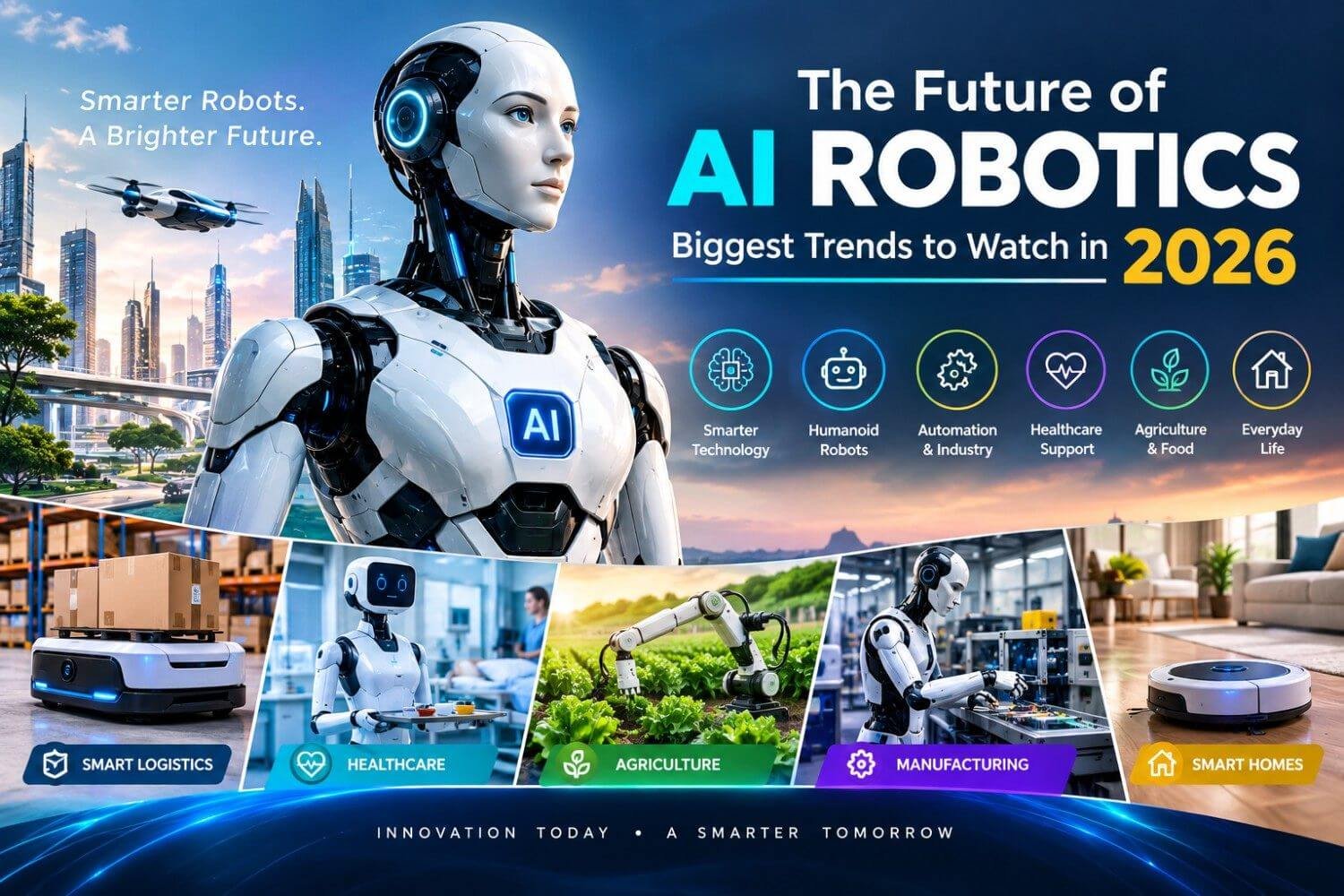
Artificial intelligence has already changed the way people search for information, create content, write software, run businesses, and communicate online. However, one of the most important developments in technology is happening beyond computer screens. Artificial intelligence is now being combined with physical machines, giving robots the ability to understand their surroundings, process information, learn from experience, and perform increasingly complex tasks. This combination, known as AI robotics, is expected to play a major role in shaping industries and everyday life in the years ahead.
The year 2026 is becoming an important period for robotics technology. Companies around the world are investing heavily in intelligent machines that can move independently, understand human instructions, work alongside employees, and adapt to changing environments. The growing attention around humanoid robots has also made the future of robotics one of the most discussed topics in the technology industry. While fully independent human-like robots are still developing, recent progress shows that intelligent machines are becoming more practical for real-world use.
What makes today’s AI robots different from many traditional robots is their increasing level of flexibility. Older machines were usually designed to perform one specific task repeatedly. They worked extremely well in controlled environments but often struggled when conditions changed. Modern artificial intelligence robotics is focused on solving this limitation. By combining machine learning, computer vision, advanced sensors, language processing, and improved hardware, developers are working toward robots that can respond to situations instead of simply following fixed instructions.
The future of robotics will not be defined by a single type of machine. Some robots will be designed for factories, while others will support hospitals, warehouses, farms, offices, and homes. Some may look like humans, while others will have completely different designs based on the tasks they need to perform. What connects all of these developments is the growing importance of AI technology and the ability of machines to become smarter, safer, and more useful.
In this article, we will explore the biggest AI robotics 2026 developments, the most important robotics trends, and how smart robots could influence businesses, workers, and society.
AI Robotics Is Changing the Traditional Meaning of Automation
For decades, robots have been an important part of industrial automation. Manufacturing companies have used robotic systems for welding, assembly, packaging, painting, and other repetitive tasks. These machines helped businesses improve speed, consistency, and productivity. However, most traditional robots were designed to operate in predictable environments where every movement could be carefully programmed.
This approach works well when the environment remains the same. A factory robot can repeat the same action thousands of times with impressive accuracy. The challenge appears when something unexpected happens. If an object is in the wrong position or the robot is asked to perform a new task, traditional systems often require human intervention or additional programming.
AI robotics is helping change this model by giving machines more advanced capabilities. Artificial intelligence can help robots analyze information from cameras and sensors, recognize objects, understand patterns, and make decisions based on the situation. This does not mean that robots suddenly think exactly like humans, but it does mean they are becoming more capable of handling situations that cannot be solved with simple pre-programmed instructions.
For example, an intelligent warehouse robot may need to move around workers, shelves, boxes, and other machines. The environment is constantly changing. AI technology can help the robot understand what is happening around it and select a safe path instead of depending entirely on one fixed route.
This greater flexibility is one of the most important reasons why AI robotics is attracting so much attention. The real world is unpredictable, and robots must become more adaptable if they are going to operate successfully outside carefully controlled environments.
Humanoid Robots Are Becoming One of the Biggest Trends in 2026
Among all the robot trends 2026, humanoid robots are receiving some of the most attention. These robots are designed with a structure that resembles the human body, usually including a torso, arms, hands, legs, and a head.
The main reason behind developing humanoid robots is not simply to create machines that look like people. The human-like design can be useful because many workplaces and environments were created specifically for humans. Buildings have stairs, doors, shelves, tools, and workspaces designed around the size and movement of the human body.
A humanoid robot could potentially operate in these spaces without requiring companies to redesign everything for a machine.
For example, a robot with arms and hands may be able to pick up objects or use certain tools. A robot with legs could potentially move through spaces that are difficult for wheeled machines. This flexibility makes humanoid robots an interesting option for businesses that need machines capable of performing different physical tasks.
However, creating a useful humanoid robot is extremely difficult. Human movement involves balance, coordination, vision, and constant adjustments. A person can walk across an uneven surface, pick up objects of different shapes, avoid obstacles, and respond quickly to changes. Recreating these abilities in a machine requires advanced robotics technology and powerful AI systems.
In 2026, humanoid robots are expected to move further from demonstrations and research environments toward limited real-world applications. Early use cases are likely to focus on structured workplaces where robots can perform repetitive physical tasks.
Potential applications may include:
- Warehouse and logistics operations
- Manufacturing support
- Moving materials
- Repetitive physical tasks
- Dangerous industrial environments
- Basic assistance work
Despite the growing excitement, widespread adoption will depend on cost, safety, reliability, and performance. A humanoid robot must provide enough value to justify the investment. Businesses will carefully evaluate whether these machines can work consistently over long periods.
Still, the rapid development of humanoid robots shows how the future of robotics is moving toward machines that can perform a broader range of activities.
Smart Robots Will Become More Common in Workplaces
The growing use of smart robots is not limited to humanoid machines. In fact, many of the most practical developments in AI robotics are happening with robots designed for specific industries.
A smart robot uses sensors, software, and AI technology to collect and process information about its environment. Depending on its design, it may be able to navigate independently, recognize objects, avoid obstacles, or respond to changing conditions.
Warehouses are one of the most important examples. Modern logistics operations involve large amounts of inventory moving through facilities every day. Products must be stored, organized, transported, and prepared for delivery quickly and accurately.
AI robots can help automate some of these processes. Instead of relying entirely on workers to move products across large warehouses, autonomous machines can transport materials and support inventory operations.
The important difference between traditional automation and intelligent robotics technology is adaptability. A fixed automated system performs the same operation repeatedly. A more advanced AI robot can potentially change its path, respond to an obstacle, or adjust its behavior when the environment changes.
This makes smart robots useful in places where conditions are not completely predictable.
In the coming years, AI robots are expected to become increasingly common in warehouses, factories, hospitals, airports, retail locations, and other large facilities. Their role may be to support workers rather than completely replace them.
For businesses, the main benefit is not simply reducing the number of employees. Robotics technology can also help improve efficiency, reduce physically demanding work, and allow employees to focus on tasks that require human judgment.
AI Robots Are Learning How to Understand Their Environment
A robot cannot perform useful tasks unless it understands what is happening around it. This is one of the biggest challenges in artificial intelligence robotics.
Humans naturally understand their surroundings. When a person enters a room, they can quickly identify furniture, doors, people, and objects. They can estimate distances and understand which objects can be moved or used.
Robots require technology to achieve similar awareness.
Computer vision is one of the most important tools helping AI robots understand the physical world. Cameras and visual sensors collect information, while AI systems analyze that information.
A robot may use computer vision to recognize a box, identify a person, detect an obstacle, or understand where an object is located.
This capability becomes especially important when robots operate in busy environments.
Imagine an AI robot working in a warehouse. A worker may suddenly walk into its path. A box may be placed in an unexpected location. Another machine may be moving nearby.
The robot needs to recognize these changes and respond safely.
Advanced AI technology can help machines process this information more effectively. Instead of treating every object as a simple image, robots are becoming better at understanding what objects are and how they relate to their environment.
Improved computer vision will be a major part of the future of robotics because intelligent machines need environmental awareness before they can operate independently.
Natural Language Could Make Robots Easier to Use
One of the most exciting developments in AI robotics is the possibility of more natural communication between humans and machines.
Traditional robots often require specialized programming or technical commands. This can make them difficult for ordinary users to operate.
Artificial intelligence is changing this by improving natural language understanding.
In the future, a person may be able to give a robot instructions using ordinary language. Instead of entering detailed programming commands, a worker could tell the machine what needs to be done.
For example, a warehouse employee could ask a robot to move specific materials to another location. A home assistant robot could potentially be asked to perform a simple household task.
However, understanding language is only one part of the challenge.
If a person tells a robot to bring an object from another room, the machine must understand the instruction, identify the correct object, navigate safely, and physically interact with the item.
This requires several advanced technologies to work together, including language processing, computer vision, movement planning, sensors, and robotics systems.
The growing connection between AI technology and robotics could make machines much easier to use. People may not need advanced programming knowledge to communicate with robots in the future.
This could be an important step toward making smart robots more practical for businesses and everyday users.
Manufacturing Will Continue to Be Transformed by AI Robotics
Manufacturing remains one of the most important industries for robotics technology. Robots have already played a major role in production for many years, but artificial intelligence robotics could make automation more flexible and intelligent.
Traditional industrial robots are highly effective when performing predictable tasks. However, modern manufacturing environments often require more flexibility. Products change, customer demands evolve, and companies need to respond quickly.
AI robotics can help address these challenges.
Computer vision systems can inspect products and identify possible defects. Machine learning can analyze production data and help businesses identify patterns. AI technology can also support predictive maintenance by analyzing equipment performance and detecting signs that a machine may require attention.
This can help companies prevent unexpected breakdowns and reduce costly downtime.
AI robots may also help manufacturers perform tasks that require more flexibility than traditional automation systems can provide.
Important applications include automated quality inspection, material handling, intelligent assembly, predictive maintenance, warehouse operations, and collaboration with human employees.
The future technology of manufacturing is likely to involve a combination of people, software, automation systems, and intelligent machines.
Rather than replacing every worker, robotics technology may change the type of work people perform. Employees could spend less time completing repetitive physical tasks and more time managing systems, solving problems, and making important decisions.
Human-Robot Collaboration Will Become More Important
One of the biggest misunderstandings about AI robotics is the idea that every new robot is designed to replace a human worker.
In reality, many robotics systems are being developed to work alongside people.
Humans and machines have different strengths. Robots can perform repetitive tasks consistently and handle certain types of physical work for long periods. Humans are generally better at communication, creativity, emotional understanding, and dealing with completely unfamiliar situations.
The future of robotics may depend heavily on combining these strengths.
In a warehouse, a robot may transport products while workers manage inventory and customer requirements. In a factory, a robot may handle repetitive lifting while employees focus on inspection and quality control.
This type of collaboration could improve productivity while reducing physically demanding work.
However, the growing use of AI robots will also change the skills workers need.
Employees may need training in areas such as robotics operation, automation management, AI technology, and digital systems. This means businesses and educational institutions will need to prepare workers for changing workplaces.
The most successful future technology strategies may be those that focus not only on automation but also on helping people develop the skills needed to work with intelligent machines.
Healthcare Could Benefit Significantly From AI Robotics
Healthcare is another major area where AI robotics could create meaningful changes.
Hospitals and healthcare workers face demanding workloads. Medical professionals must manage patients, equipment, information, and complex daily operations.
Robotics technology can potentially support healthcare workers by handling certain routine or logistical tasks.
Robots may transport medical supplies between different areas of a hospital. Automated systems can assist with laboratory work. Robotic technology is also being used to support certain surgical and rehabilitation procedures.
In the future, smart robots may become more useful in elderly care and patient support.
For example, robots could help with mobility, deliver supplies, or support patients with certain routine activities.
However, healthcare requires a careful approach.
Medical professionals make complex decisions that depend on experience, communication, ethics, and emotional understanding. AI robots should be viewed primarily as tools that support healthcare workers.
The greatest value may come from allowing doctors and nurses to spend more time focusing directly on patients while technology handles certain repetitive activities.
As artificial intelligence robotics improves, healthcare could become one of the industries where human-machine collaboration creates significant benefits.
Autonomous Mobile Robots Are Changing Logistics
Autonomous mobile robots are becoming increasingly important in modern logistics operations.
Unlike traditional robots that remain in one fixed location, these machines can move independently through a facility.
They use sensors, cameras, maps, and AI technology to navigate.
A mobile robot may transport products from one location to another, deliver supplies, or support inventory management.
Warehouses are particularly suitable environments for this technology because employees often spend significant time moving materials across large spaces.
AI robots can help automate transportation and improve efficiency.
As e-commerce continues to grow, businesses need faster and more organized logistics operations. Robotics technology can help companies manage large volumes of products.
One important challenge is safety.
Mobile robots must operate around workers and other equipment. AI technology and sensors help them detect obstacles and navigate safely.
In the future of robotics, autonomous machines may become increasingly common in logistics facilities. Instead of replacing every human worker, they could handle transportation tasks while employees focus on more complex responsibilities.
Agriculture Is Becoming an Important Area for Smart Robots
Agriculture is facing major challenges related to labor shortages, rising costs, climate conditions, and the need to produce food more efficiently.
AI robotics could help farmers address some of these challenges.
Smart robots can use cameras and sensors to monitor crops and collect information about agricultural conditions. AI systems can analyze this data and help identify problems.
For example, robotics technology may help detect unhealthy plants or identify areas that require additional attention.
Agricultural AI robots may also be used for planting, harvesting, weed management, and crop monitoring.
The goal is not only to automate physical work. Artificial intelligence can also help improve decision-making.
A farmer may receive more detailed information about crop conditions, allowing resources such as water and fertilizer to be used more efficiently.
The future technology of agriculture could involve a combination of AI robots, drones, sensors, automated equipment, and data analysis.
As the global demand for food continues to increase, intelligent robotics technology may become increasingly valuable for creating more efficient farming systems.
AI Robots Could Eventually Become Part of Everyday Life
For many people, the most interesting part of the future of robotics is the possibility of intelligent machines becoming part of everyday life.
Robotic vacuum cleaners have already shown that automation can be useful in homes. However, future smart robots could perform more advanced activities.
Potential applications could include household assistance, cleaning, simple organization, home monitoring, elderly support, and assistance for people with disabilities.
A more advanced home robot would need to understand a complex environment.
Homes are unpredictable. Furniture may be moved. Objects can be placed anywhere. Children and pets may move unexpectedly.
This makes household robotics much more difficult than operating a machine inside a controlled factory.
Privacy is another important concern.
Home AI robots may use cameras, microphones, and sensors to understand their surroundings. Companies will need to provide strong protections for personal information.
Despite these challenges, improvements in AI technology could gradually make household robots more practical.
The future may not involve one human-like robot performing every household task. Instead, people may use different types of smart robots designed for specific needs.
Better Hardware Will Drive the Next Generation of Robotics
AI robotics depends on more than software.
Even the most advanced artificial intelligence system cannot operate successfully if the robot lacks reliable hardware.
Robots require sensors to collect information, processors to analyze data, motors to create movement, and batteries to provide energy.
One of the biggest challenges for advanced AI robots is battery life.
Humanoid robots, for example, require significant energy to walk, balance, move their arms, process information, and perform tasks.
Improved batteries and energy-efficient systems could make a major difference.
Sensors are also becoming more advanced.
Robots may use cameras to see their surroundings, depth sensors to understand distances, microphones to process sound, and force sensors to interact safely with objects.
The future of robotics will depend on continued improvements in both hardware and AI technology.
A robot needs intelligence, but it also needs the physical ability to interact successfully with the real world.
Safety, Privacy, and Ethics Will Shape the Future of AI Robotics
The rapid growth of AI robotics also creates important questions.
As robots become more autonomous and capable, developers must focus carefully on safety.
A robot working around people must be able to recognize dangerous situations and respond appropriately.
Cybersecurity is also an important issue.
Connected robots may be vulnerable to digital attacks if companies do not provide strong security protections.
Privacy must also be considered, particularly for robots that use cameras, microphones, and sensors.
The future of robotics will therefore depend on responsible development.
Important areas include:
- Human safety
- Data privacy
- Cybersecurity
- Responsible AI development
- Human oversight
- Accountability
- Clear safety standards
Governments and technology companies will need to work together to create systems that encourage innovation while protecting people.
Public trust will be essential.
People are more likely to accept AI robots when they understand how the technology works and believe that it is being developed responsibly.
Multi-Purpose Robots Could Become the Next Big Goal
Many robots are currently designed for specific tasks.
A warehouse robot may be excellent at moving products but unable to perform other activities.
The long-term goal of artificial intelligence robotics is to create machines that are more flexible.
Multi-purpose AI robots could potentially learn different skills and perform a wider range of tasks.
This would make robots more valuable because businesses would not need separate machines for every activity.
For example, one smart robot could potentially move materials, organize products, inspect equipment, and perform other tasks depending on the instructions it receives.
Creating such machines is extremely challenging because the real world is complex.
A robot must understand different environments and situations while remaining safe and reliable.
However, the development of flexible, general-purpose machines remains an important part of the future technology vision.
How AI Robotics Could Change Jobs and the Global Economy
The growing use of AI robots could have a major impact on businesses and the global economy.
Companies may use robotics technology to improve productivity, reduce repetitive work, and address labor shortages.
At the same time, automation could change the type of work people perform.
Some jobs involving repetitive physical activities may become increasingly automated.
However, new opportunities could emerge in areas such as robotics engineering, AI development, automation management, robot maintenance, cybersecurity, and technical support.
The key challenge will be preparing workers for these changes.
Technology itself does not determine whether automation creates positive outcomes. Education, training, and access to new opportunities will play an important role.
Businesses should focus on helping employees develop new skills instead of simply viewing robotics technology as a replacement for human workers.
The future of robotics could create significant opportunities, but societies will need to prepare for the changes that intelligent automation brings.
What Can We Expect From AI Robotics Beyond 2026?
The future of AI robotics is still developing, and progress will likely happen step by step.
We are unlikely to suddenly see fully capable robots performing every human task.
Instead, AI robots will gradually become better at specific abilities.
They will improve their ability to understand language, recognize objects, navigate environments, and learn from experience.
Humanoid robots may begin with structured tasks in controlled environments before becoming capable of handling more complex situations.
Autonomous robots will continue expanding in warehouses, factories, hospitals, and other industries.
Smart robots may also become more common in homes as technology becomes safer and more affordable.
The most important long-term development may be flexibility.
The future of robotics is moving away from machines designed for only one repetitive task and toward intelligent systems capable of adapting to different situations.
AI technology will play a central role in this transformation.
As robots become better at understanding and interacting with the physical world, they could eventually become as important to everyday work as computers and smartphones are today.
Read Also: https://aitechytrend.com/chatgpt-vs-gemini/
Conclusion
The future of AI robotics is one of the most exciting areas of technology in 2026. Artificial intelligence is helping robots move beyond simple automation and become more capable of understanding, learning, and interacting with the world around them.
The biggest robotics trends are showing progress across several important areas. Humanoid robots are moving closer to practical applications, smart robots are becoming more useful in workplaces, autonomous mobile machines are transforming logistics, and artificial intelligence robotics is creating new possibilities in healthcare and agriculture.
The future of robotics will not depend on robots replacing humans completely. In many cases, the greatest opportunities will come from collaboration. AI robots can handle repetitive, physically demanding, or dangerous tasks, while humans focus on creativity, communication, decision-making, and complex problem-solving.
However, the growth of robotics technology also brings important responsibilities. Safety, privacy, cybersecurity, ethics, and workforce development will all play an essential role in determining how successfully AI robots become part of society.
The technology is still developing, and many challenges remain. Yet the progress being made in AI robotics 2026 makes one thing clear: intelligent machines are likely to play an increasingly important role in the future technology landscape.
The coming years could bring major changes to industries, workplaces, and everyday life. As AI technology continues to improve, smart robots may become more capable, more accessible, and more useful than ever before.
Frequently Asked Questions
1. What is AI robotics?
AI robotics is the combination of artificial intelligence and robotics technology. It helps robots understand information, recognize objects, learn from data, and respond more effectively to their environment. AI robots can use machine learning, computer vision, sensors, and other advanced technologies to perform tasks more intelligently.
2. What are the biggest AI robotics trends in 2026?
The biggest robotics trends in 2026 include the development of humanoid robots, autonomous mobile robots, improved computer vision, natural language communication, collaborative robots, healthcare robotics, agricultural automation, and more advanced smart robots capable of adapting to changing environments.
3. Will AI robots replace human workers?
AI robots may automate certain repetitive and physically demanding tasks, but they are unlikely to completely replace humans in every workplace. Many industries are expected to focus on human-robot collaboration, where machines support workers while people handle tasks that require creativity, communication, judgment, and complex decision-making.
4. How will AI robots be used in everyday life?
AI robots could be used in homes, hospitals, warehouses, factories, farms, and many other environments. They may help with cleaning, logistics, elderly assistance, healthcare support, manufacturing, delivery, and other repetitive or physically demanding activities.
5. What is the future of robotics after 2026?
The future of robotics is expected to focus on creating machines that are more intelligent, flexible, and capable of working safely with humans. Future AI robots may become better at understanding language, learning new tasks, navigating complex environments, and performing a wider range of real-world activities as AI technology and robotics technology continue to improve.